Sunday, January 30, 2022
Where do I report my UFO sighting?
Where do I report my UFO sighting?
So, you think you’ve seen a UFO! Congratulations!
Now what?
Well, you’ve joined a somewhat exclusive club. Surveys and statistical studies have suggested that one out of every ten North Americans has seen a UFO. There are reports on record from a very broad spectrum of people, from pilots to farmers, and from children to seniors, all genders, from coast to coast to coast (to coast).
The difference is that this data comes from UFO reports,
and you haven’t reported your sighting yet.
Other surveys have shown that only one in ten of all UFO
witnesses will ever bother to make a formal report of a sighting, so that means
you have to decide if you want to file one or not.
But how? And to whom, or which organization?
Unfortunately, there isn’t one central location to report a UFO. This, despite the apparent huge amount of interest and publicity and media attention to the subject. But the fundamental basis for ufology is the UFO report itself, and there’s not much being done to gather this actual data, upon which is built all the speculation concerning UAP propulsion, physical composition, and (by ET believers) the aliens themselves.
I found that Googling “How do I report a UFO” generates five answers.
The first is “UFO Daddy”, which directs you to the Mutual
UFO Network (MUFON), a private organization of UFO fans that trains teams of
Field Investigators (FIs) to investigate your UFO sighting.
The second hit is a UFO FAQ on HubPages, which first
notes: “According to NASA’s web page,
you should report UFO sightings to 911, or your local emergency number.
However, there is no official government agency that is responsible for
investigating sightings.” However, the web page in question has nothing to do
with UFOs and the original must have been deleted long ago. Curiously, if you
search for “UFO” on that NASA web page, you get one link
that is to an explanation about how an unusual object photographed during
Apollo 16 was actually a long boom and floodlight attached to the spacecraft.
But with no relevance to a typical UFO sighting.
The other three answers are garbage UFO sites with
general comments from readers.
It seems like the first option is the best: MUFON. If you go to its website, you can find a link to a page for reporting a UFO to them.
Done!
Oh, wait, what about the suggestion to reporting UFO sightings to 911? That’s a very reasonable possibility. After all, that way you can lodge a formal complaint and you know that police do have investigators that will do something about it. Maybe you should do that first.
Or not. Because calling 911 about a UFO sighting may take an emergency responder away from a call about a medical emergency or a heinous crime in progress. No, don’t do that.
That site also noted that “there is no official government agency that is responsible for investigating sightings.”
But haven’t we heard in the media and news recently that
there is such an agency? Wouldn’t it be better to report a UFO sighting to an
official body?
I guess so, but how, exactly? NASA seems uninterested, despite what we found. What about the air force?
The USAF website
says the following: “Persons wishing to report UFO sightings should be advised
to contact local law enforcement agencies.”
That’s funny. I thought the USAF had a task force to
investigate UFOs (or UAPs, as they are called now, apparently).
Oh, it’s the US Navy is going
to be investigating UFOs. But there’s no indication of how they will
collecting UFO or UAP data, nor how an average citizen can report a sighting.
In fact, Pentagon’s Task Force on UAPs issued its first report and noted that
only a
relative handful of military UAP sightings were studied. (Only 144, to be
exact.) Its report noted that its investigation: “…remains limited to USG
reporting.”
So although the Department of Defense is going to be studying UFO/UAP reports to see if any are a threat to national security, they aren’t interested in your personal sighting. But you might try anyway, by emailing the USAF with your sighting details. Otherwise, maybe do what the USAF suggests, and report your sighting to your local police.
Good luck with that.
Okay, what about other UFO groups and organizations?
Absolutely. Many are very eager to get your sighting
reports. Many have websites with online forms to fill out.
A significant one is the National UFO Reporting Center
(NUFORC), based in Washington State. They get many hundreds of cases each
year reported to them, and their info is open to the public, unlike MUFON,
whose case reports are private. So if you want others to know what you saw,
NUFORC is a good option.
Another is UFOs Northwest,
originally devoted to the American Northwest, but now accepting reports from
all around the world. They also post details of everyone’s UFO sightings and allow
for comments and letters.
A group with a good website is UFO Hunters. They are
exactly what they say they are, a group of people dedicated to searching for
UFOs, and readily acknowledge the work of NUFORC and MUFON. UFO Hunters has an
added bonus of providing an interactive map that shows UFO activity around the
world, and has a searchable index.
The group with historically the best record is the Center for UFO Studies
(CUFOS). It was the creation of the “Grandfather of Ufology,” Dr. J. Allen
Hynek, who worked with the USAF and then went rogue, saying that the USAF
ignored all the good cases.
Of course, other countries have their own UFO groups and organizations, all of which accept UFO sighting reports. The largest of these is the British UFO Research Association (BUFORA). In Italy, there’s the Centro Italiano Studi Ufologici (CISU), and they have an online UFO report form you can email to them. A French group, Groupe d'Études et d'Informations sur les Phénomènes Aérospatiaux Non-identifiés (GEIPAN), is very active and has an interactive website where you can not only report your UFO sighting, but also triage it, so you might be able to yourself identify what you saw. There are other groups around the world, and you can search for them online. (Here’s what Wikipedia says.)
In North America, both Canada and Mexico also have groups that investigate UFOs. Canada is particularly of interest, because not only are there civilian UFO groups, but its government also has taken an interest in UFOs.
The Canadian
UFO Survey has been cataloguing UFO sightings there for more than 30 years.
An online
web form can send them your report if you see one in Canada. There’s a
second form to reach them on a
podcast website.
The Canadian UFO Survey includes sightings reported to a
host of other groups in Canada, such as UFOBC,
Quebec based groups such as Groupe
d’assistance et de recherche sur les phénomènes aérospatiaux non-identifiés
(GARPAN) and Association
Québécoise d’Ufologie (AQU), plus Canadian cases reported to MUFON and
NUFORC.
The Canadian UFO Survey also includes reports of UFOs
made to the Canadian government. This includes Transport Canada, the Canadian
equivalent of the Federal Aviation Administration (FAA). Pilots are required to
report UFOs as per “AIP CANADA Part 2 - Enroute (ENR)”:
“Communication Instructions for Reporting Vital Intelligence Sightings (CIRVIS) reports should be made immediately upon a vital intelligence sighting of any airborne and ground objects or activities that appear to be hostile, suspicious, unidentified or engaged in possible illegal smuggling activity. Examples of events requiring CIRVIS reports are: unidentified flying objects…” (https://www.navcanada.ca/en/2enreng27january2022.pdf) (Retrieved 29 January 2022)
In addition to pilots, civilians have been known to file UFO reports as “Aviation Incidents,” and there is separate form for drone incidents. (Drones have been blamed for many UFO sightings.) These incident reports usually are available as Civil Aviation Daily Occurrence Reporting System (CADORS). The justification for reporting UFOs is broadly interpreted as: “Any occurrence which may generate a high degree of public interest or concern or could be of direct interest to specific foreign air authorities.”
In regard to the FAA in the USA, all its website says
regarding reports of UFOs is that: “Persons wanting to report
UFO/unexplained phenomena activity should contact a UFO/ unexplained phenomena
reporting data collection center, such as the National UFO Reporting Center,
etc.” and “If concern is expressed that life or property might be endangered,
report the activity to the local law enforcement department.” The FAA
equivalent to the Transport Canada incident report seems to be
FAA 8020-23. (You can report a drone
to the FAA too.)
It is interesting to note that the FAA
Order 8020.11D has a section on “Spacecraft incidents," which can be
investigated under Chapter 7(8)e, noting that: “the Associate Administrator for
Commercial Space Transportation (AST) has the authority to conduct independent
investigations parallel to an NTSB investigation, including, but not limited to
the following: (1) Accidents not investigated by the NTSB. (2) Incidents or
other identified mishaps.” So I suppose technically, the FAA could investigate
UFO reports under this Order.
But I digress.
Finally, one has to acknowledge that social media is
possibly the best way to share your UFO sighting with others. In theory, it’s
the most efficient; if all states and provinces had their own separate Facebook
groups for reporting UFOs, it would be a tremendous boost to UFO/UAP
investigations. Unfortunately, UFO information on social media is in a state
akin to the Wild West, with disparate groups that have conflicting agendas
controlling the discourse.
Yet, one can find pockets of interactions that have
useful information.
In Canada, for example, there are Facebook groups where
witnesses in specific provinces report their sightings and others are able to
comment (and criticize and flame, unfortunately). The same is true of most US
States.
You can find many, many UFO videos posted on YouTube
(just search for them), but beware of misinformation and sensational channels
that exploit believers.
Possible one of the better sources of UFO info on social
media is Reddit, where subreddits
on specific UFO topics can provide good insight. In fact, the subreddit lists
some way to report your UFO sighting, including: the National Aviation
Reporting Center on Anomalous Phenomena (NARCAP) (which has info for pilots to report their UFO sightings);
MUFON; The Black Vault; and Aerial Phenomena Investigations (API), which also accepts UFO sighting reports.
(In fact, API notes that:
“It’s fine to report your sighting to NUFORC, but raw, uninvestigated sightings
have very little weight on their own.”)
The other organization mentioned, The Black Vault, is a
site created by UFO researcher John Greenewald, whose primary interest is
retrieving government documents on various topics, many of which are
UFO-related. Nevertheless, his site has a link for
reporting UFO sightings, conducted by TBV Investigations (operated by Tiffany Hahn, a licenced private investigator
with an interest in the paranormal.)
In other social media, there are some UFO groups and researchers on Twitter, such as the aforementioned UFO Hunters, among many others. Also, many people post Tweets with the hashtag #ufotwitter, which has dozens and dozens of Tweets posted every day.
One thing to consider is that despite the many groups mentioned so far that have links to UFO reporting forms and mechanisms, some may not have the resources or capabilities to investigate UFO reports. You may live hundreds or thousands of miles away from where a group’s investigators live, and how would they visit you and examine where the UFO was seen or landed?
Finally, it’s worth noting that if you see a UFO and report it, your observation may not be considered as useful data for “solving the UFO mystery” at all. The UAPTF doesn’t seem to be interested in civilian UFO reports, just those experienced by military personnel and perhaps recorded by radar and video. The recently formed Galileo Project, which includes a lot of scientists who are interested in the UFO phenomenon, is not interested in the average UFO report. Its founder has been quoted as saying that: “...the best sightings would be those that did not involve humans. He wanted instruments to collect the data without human interaction. He wanted to remove errors that were often generated by human perception and human bias.”
So there you have it. It’s not that there are no ways to report your UFO sighting – it’s that there are so many options. Do you want your report to go the government for its UFO/UAP study? Do you want your report to go to a private UFO group? Do you want to share your UFO/UAP experience with others? MUFON has recently made its database completely closed to non-subscribers, so it’s not open for public viewing, but maybe it’s worth it for you to open your wallet or purse and join them in their quest to understand UFOs. NUFORC might be a good bet for sharing your UFO experience and allowing others to read about what you’ve seen, if that’s your goal.
Maybe you should take care in observing the UFO, noting all relevant details such as those listed on UFO reporting forms, and hang onto your information. Perhaps start a “UFO diary” to record your sighting(s).
Regardless of what you decide, you’re not alone. (No, I’m not necessarily talking about aliens visiting Earth.) Polls and studies have suggested there are at least 35 million people in the United States alone who believe they have seen a UFO.
It’s now up to you.
[NB: All URLs were live as of January 29, 2022. Special thanks for Curt Collins and Ralph Howard for their comments and insight. Thanks also to Mark Rodeghier and Isaac Koi.]
Labels: UFO report sighting ufology groups military UAPTF MUFON NUFORC CUFOS witness

Monday, February 06, 2023
The 2022 Canadian UFO Survey
The 2022 Canadian UFO Survey
Overview
Since 1989, Ufology Research (formerly Ufology Research of Manitoba) has solicited UFO case data from known and active investigators and researchers in Canada. The goal has been to provide data for use by researchers trying to understand this controversial phenomenon.
2022 marked the 34th year of collecting and analysing Canadian UFO report data by Ufology Research, with the total number of Canadian UFO reports in the database now more than 23,500 in total. Tables of most Canadian UFO reports included in the annual surveys from 1989 to the present are available online at: http://survey.canadianuforeport.com
The 2022 Canadian UFO Survey: Summary of Results
• There were 768 UFO sightings recorded in Canada in 2022, a slight increase of about six per cent from 2021. The number of UFO sightings reported in Canada in 2022 was the fourth-lowest over the past 20 years.
• In 2022, Quebec led all Canadian provinces with about 29 per cent of all Canadian UFO reports, edging out Ontario’s 28 per cent. This is the first time that Quebec has recorded the most Canadian UFO reports in a single year since the Canadian UFO Survey began in 1989. BC had 14 per cent, unchanged from 2021, and other provinces and territories had negligible changes in report numbers from the previous year.
• In 2022, about 8.2 percent of all UFO reports were classified as unexplained.
• The typical UFO sighting lasted approximately 13 minutes in 2022.
• Based on the number of reports in 2022 and using the average number of witnesses per case as 1.37, more than 1,000 Canadians had sightings of UFOs in 2022.
• The study found that in 2022, about 52 per cent of all UFO sightings were of simple lights in the sky, similar to previous years. Witnesses also reported triangles, spheres, and boomerangs.
Results of this study show that many people continue to report unusual objects in the sky, and some of these objects do not have obvious explanations. Many witnesses are pilots, police and other individuals with reasonably good observing capabilities and good judgement.
At least two UFO sightings are reported each day in Canada. Some of these could have explanations such as military exercises and overflights occurring over populated areas. In addition, people are often unaware of the nature of conventional or natural objects in the sky, such as Starlink satellite constellations and large meteors. The good news is that people are taking the time to observe their surroundings, and making a conscious effort to report them to organizations and agencies seeking to monitor UFO activity.
Popular opinion to the contrary, there is no incontrovertible evidence that some UFO cases involve extraterrestrial contact. The continued reporting of UFOs suggests a need for further examination of the phenomenon by social, medical and/or physical scientists.
UFO reports in Canada
The following shows the number of reported UFOs per year since 1989, collected by Ufology Research.

The number of UFO reports per year has varied, although there has been a general trend towards a gradual increase in yearly UFO report numbers over the past 30 years until 2015, and then a slow but steady decline. Media reports of a “huge increase” in UFO reports are not supported by available data. The six per cent increase in UFO reports in 2022 over 2021 is largely due to 37 separate reports filed by one individual regarding objects with definitive explanations. Without these cases, there would be no negligible increase in UFO reports last year at all.
Although there may be a perceived notion that UFOs are not being reported with as much frequency as in the past, UFOs have not “gone away.” This data clearly contradicts comments by those who would assert that UFOs are a ‘passing fad’ or that UFO sightings are decreasing.
For this study, the working definition of a UFO was: “an object seen in the sky which its observer cannot identify.”
Although the term Unidentified Aerial Phenomenon (UAP) is currently being used more often instead of Unidentified Flying Object (UFO), for consistency this study will continue to use the original term UFO that was in use when the study began in 1989.
Polls have shown that about ten per cent of the Canadian population believe they have seen UFOs. This means that about 3.7 million Canadians have seen UFOs. However, studies have also shown that only about ten per cent of all witnesses of UFOs report their experiences (although this percentage is thought to be much lower).
UFO witnesses range from farmhands to airline pilots and from teachers to police officers.
Witnesses represent all age groups and racial origin. What is being observed? In most cases, only ordinary objects. However, this begs a question. If people are reporting things that can be explained, then the objects they observed were “really there.” Were the objects we can't identify “really there” as well? If so, what were they?
These are questions that only continued and rational research can answer, and only if researchers have the support and encouragement of both scientists and the public.
Method
Data for each UFO case was obtained by Ufology Research from participating researchers across Canada, through receipt of reports directly from witnesses, or through data mining of known websites devoted to UFO reports. This method has not changed significantly during the past 30 years.
Sources for the 2022 Canadian UFO cases included:
UFO groups and organizations: AQU, AUFOSG, GARPAN, KBCCUFO, MUFON, NUFORC, UFOBC, Ufology Research, UFOSNW
Government sources: Transport Canada, CIRVIS reports
Social media: Facebook, Reddit, Twitter, YouTube
The original intent of the Canadian UFO Survey was to understand exactly how many cases were being reported in a given year, and how they were distributed across the country. It was also deemed desirable to know other characteristics of the UFO reports, such as predominant colours, the durations of sightings, reported shapes, and which UFO types were most common.
The information available on each case was then coded by members of Ufology Research, entered into a database, and statistically analysed. Information on almost all UFO sightings in 2022 was obtained through online sources.
An example of the coding key is as follows:
Example: 2022 01 09 1530 Vernon BC DD 900 silver 2 ps 6 5 UFOBC p 4 objs. seen
Field: 1 2 3 4 5 6 7 8 9 10 11 12 13 14 15 16
Field 1 is a default YEAR for the report.
Field 2 is the MONTH of the incident.
Field 3 is the DATE of the sighting.
Field 4 is the local TIME, on the 24-hour clock.
Field 5 is the geographical LOCATION of the incident.
Field 6 is the PROVINCE where the sighting occurred.
Field 7 is the TYPE of report, using the Modified Hynek Classification System.
Field 8 is the DURATION of the sighting, in seconds (a value of 600 thus represents 10 minutes).
Field 9 is the primary COLOUR of the object(s) seen
Field 10 is the number of WITNESSES
Field 11 is the SHAPE of the object(s) seen
Field 12 is the STRANGENESS of the report.
Field 13 is the RELIABILITY of the report.
Field 14 is the SOURCE of the report.
Field 15 is the EVALUATION of the case.
Field 16 includes any COMMENTS noted about the case.
Distribution of UFO reports across Canada
In 2022, Quebec led all Canadian provinces with about 29 per cent of all Canadian UFO reports, edging out Ontario’s 28 per cent. This is the first time that Quebec has recorded the most Canadian UFO reports in a single year since the Canadian UFO Survey began in 1989. BC had 14 per cent, unchanged from 2021, and other provinces and territories had negligible changes in report numbers from the previous year.
Alberta, Quebec, PEI and Newfoundland and Labrador were the only provinces with increases in report numbers in 2022 compared with 2021.

In addition, geographical names of UFO sighting locations were examined for trends. Many cities were found to have multiple reports, as noted. (Large metropolitan areas include their suburbs.)
Number of UFO Reports in Metropolitan Areas in 2022
Metropolitan Areas
Toronto 44
Vancouver 36
Montreal 32
Edmonton 23
Calgary 20
London 18
Hamilton 13
Ottawa 12
Quebec City 10
Winnipeg 8
Monthly Trends in UFO Reports
Monthly breakdowns of reports during each year tend to show slightly different patterns. UFO reports generally peak in summer and are at minimum in winter, presumably due to the more pleasant observing conditions during the summer months, when more witnesses are outside. In Canada in 2022, the monthly trend saw a distinct shift to the fall.

UFO Report Types
An analysis by report type shows a similar breakdown to that found in previous years. The percentage of cases of a particular type remains roughly constant from year to year, with some variations. Most cases were Nocturnal Lights and Nocturnal Discs, which comprised 65 per cent of cases.
Less than four per cent of all reported UFO cases in 2022 were Close Encounters, emphasizing the reality that very few UFO cases involve anything other than distant objects seen in the sky. This is an important statistic, because the current popular interest in abductions and sensational UFO encounters such as direct contact with aliens is based not on the vast majority of UFO cases but on the tiny fraction of cases which fall into the category of close encounters. Speculation on what aliens may or may not be doing in our airspace seems almost completely unconnected to the question of what are actually being reported as UFOs.
For those unfamiliar with the classifications, a summary follows:
NL (Nocturnal Light) - light source in night sky
ND (Nocturnal Disc) - light source in night sky that appears to have a definite shape
DD (Daylight Disc) - unknown object observed during daytime hours
C1 (Close Encounter of the First Kind) - ND or DD occurring within 200 metres of a witness
C2 (Close Encounter of the Second Kind) - C1 where physical effects left or noted
C3 (Close Encounter of the Third Kind) - C1 where figures/entities are encountered
C4 (Close Encounter of the Fourth Kind) - an alleged "abduction" or "contact" experience
Note: The category of Nocturnal Disc was created in the 1980s by UFOROM originally for differentiation of cases within its own report files, and has been adopted by many other groups worldwide.

Other Report Types
The category of PH indicates the sighting was entirely photographic, without any actual object seen visually. In 2022, there were about 11 per cent of these cases recorded, double the amount in 2021. Many reports listed as NL or ND or DD may also have associated photos or video, so this should not be considered exclusive.
However, about 40 per cent of all UFO reports are accompanied by photographs or videos (usually from cell phone cameras). This is one rejoinder to the complaint to there are no photos of UFOs, considering the abundance of cameras. Of course, the problem is not that there are no photos or videos of UFOs, but that there are so few good, high-quality, and information-rich useful photos of UFOs.
EV indicates a case in which physical evidence was observed (not necessarily related to any observed object) and RD is a case in which an object was detected with radar but not necessarily observed. UX cases are those in which anomalous phenomena are reported and believed by witnesses to be UFO-related, but no UFO was actually seen. These include reports of “odd sounds,” observations of strange creatures, and dreams.
Hourly Distribution
The hourly distribution of cases has usually followed a similar pattern every year, with a peak at 2200 hours local and a trough around 0900 hours local. About a third of all UFO sightings in 2022 occurred between 9 pm and 11 pm. Since most UFOs are nocturnal lights, most sightings will occur during the evening hours. Since the number of possible observers drops off sharply near midnight, we would expect the hourly rate of UFO reports would vary with two factors: potential observers and darkness.

Duration
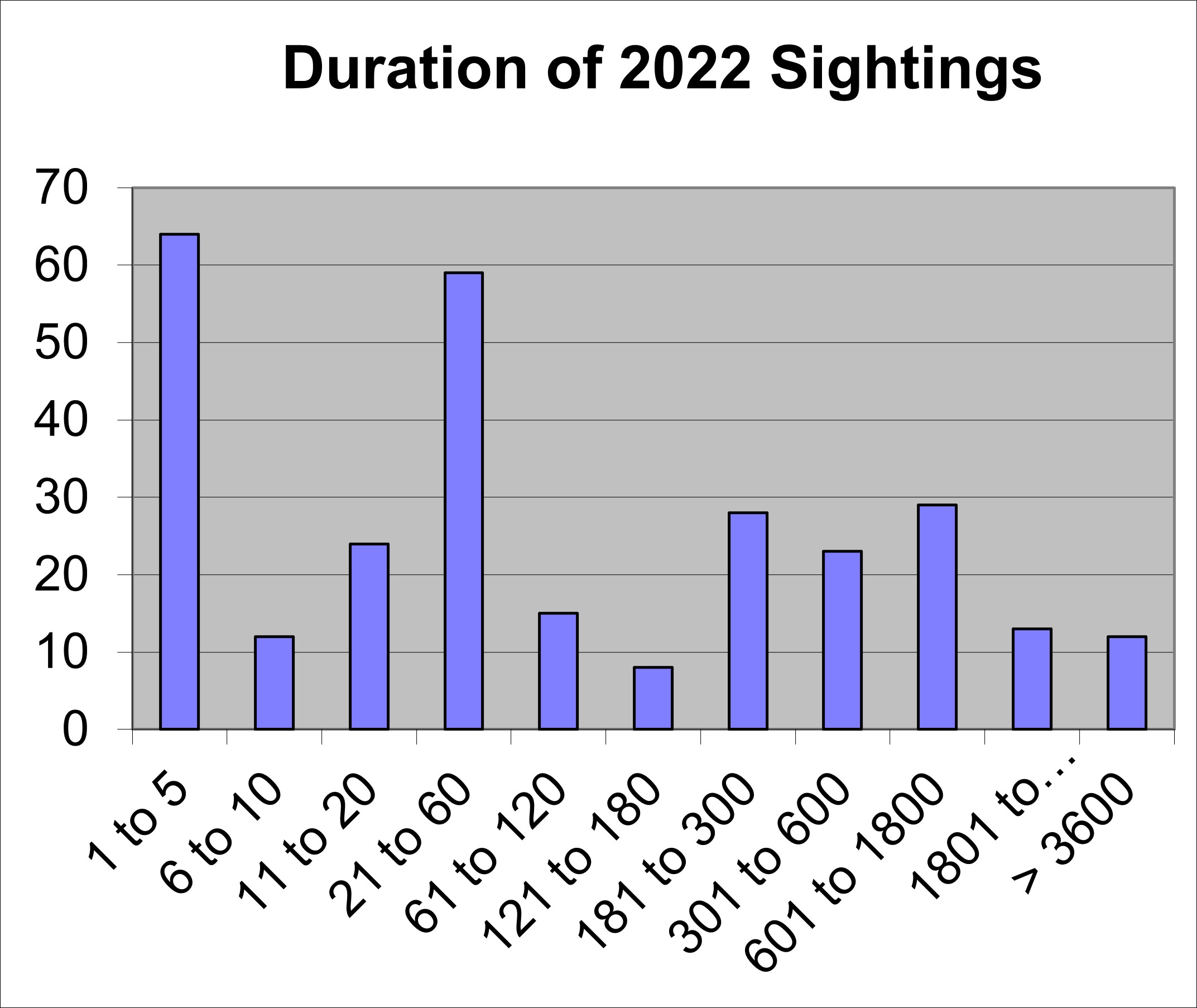
The category of Duration is interesting in that it represents the subjective length of time the UFO experience lasted. In other words, this is the length of time the sighting lasted as estimated by the witness. Naturally, these times are greatly suspect because it is known that most people tend to badly misjudge the flow of time.
Although a witness’ estimate of “one hour” may be in error by several minutes, it is unlikely that the true duration would be, for example, one minute. Furthermore, there have been cases when a UFO was observed and clocked very accurately, so that we can be reasonably certain that UFO events can last considerable periods of time.
The average duration of UFO sightings in Canada in 2022 was about 13 minutes, similar to that in 2021.
The length of time an object is seen suggests some simple explanations for what was being observed by the witness. In fact, the duration of a sighting is one of the biggest clues to its explanation. Experience in studying UFO reports has shown us that short duration events are usually fireballs or bolides, and long duration events of an hour or more are very probably astronomical objects moving slowly with Earth’s rotation. Long-duration sightings tend to occur in the early morning hours, from about midnight until 6:00 a.m.
Colour
In cases where colours of an object were reported by witnesses, the most common colour in 2022 was white, mentioned in 290 cases or 56 per cent of reports where a colour was indicated. In 2021, this percentage was 52 per cent.
This result might be related to the abundance of Starlink-related reports, which were uniformly white starlike objects. The next most common colours were orange, multicoloured, and red. Since most UFOs are nocturnal starlike objects, the abundance of white objects is not surprising.
Colours such as red, orange, blue and green often are associated with bolides (fireballs). Orange is most often associated with the observation of a Chinese lanterns, the launching of which have been popular during the past decade or so.
The ‘multicoloured’ designation is problematic in that it literally covers a wide range of possibilities. This label has been used, for example, when witnesses described their UFOs as having white, red and green lights. Many of these are certainly stars or planets, which seem to flash a variety of colours when seen low on the horizon. Aircraft are also frequently described as having more than one colour of light, such as flashing coloured red and green wing lights. However, seen from a distance, aircraft can often be visible only as moving white lights.

Witnesses
The average number of witnesses per case in 2022 was 1.37, up slightly from 2021. This value has been as high as 2.4 in 1996, indicating that a UFO experience often has more than one witness, and supports the contention that UFO sightings represent observations of real, physical phenomena, since there is usually at least one corroborator present to support the sighting.
We can then extrapolate the number of Canadians who had seen UFOs in 2021. Given the number of reports in 2022 as 768 and using 1.37 as the number of witnesses per case, we get a value suggesting that at least 1,052 Canadians saw UFOs in 2022.
The number is likely higher, as studies have shown that only about ten per cent of all UFO sightings are reported (most witnesses choose not to tell anyone, out of fear of ridicule or concern for their reputation). Multiplying by ten, this means it is probable that more than 10,000 Canadians saw UFOs in 2022, or about one in every 4,000 people.

Shape
Witnesses’ descriptions of the shapes of UFOs vary greatly. In 2022, like other years, most reported UFOs were simply “point sources”—that is, “starlike” objects or distant lights. There were 268 reports of a UFO that was only a light in 2022. The classic “flying saucer” or disc-shaped object was reported in 28 cases in 2022, down from 36 cases in 2021, and “triangles” were reported in 23 cases in 2022, slightly more than the 17 cases in 2021. Curiously, the number of reports of an object that was cigar shaped or cylindrical increased from 10 per cent in 2021 to 16 per cent in 2022.
The shape of a perceived object depends on many factors such as the witness’ own visual acuity, the angle of viewing, the distance of viewing and the witness’ own biases and descriptive abilities. Nevertheless, in combination with other case data such as duration, shape can be a good clue towards a UFO’s possible explanation.
One recurring problem is the description by a witness of a distant light as an “orb,” implying a spherical shape. The term “orb” has also been adopted by many in ufology who infer that an orb is something mysterious and distinct from a simple light. Upon interviewing witnesses who describe orbs, however, it is clear they only observed a distant light, and their personal belief in alien visitation drove them to label it as something unexplainable.

Strangeness
The assigning of a Strangeness rating to a UFO report is based on a classification adopted by researchers who noted that the inclusion of a subjective evaluation of the degree to which a particular case is in itself unusual might yield some insight into the data. For example, the observation of a single, stationary, starlike light in the sky, seen for several hours, is not particularly unusual and might likely have a prosaic explanation such as that of a star or planet. On the other hand, a detailed observation of a saucer-shaped object which glides slowly away from a witness after an encounter with grey-skinned aliens would be considered highly strange.
A Strangeness rating is assigned during the data entry process, based on the given information about each case. It is subjective, but based on the general criteria noted above.
The numbers of UFO reports according to a strangeness rating show an inverse relationship such that the higher the strangeness rating, the fewer reports. The one exception to this relationship occurs in the case of very low strangeness cases, which are relatively few in number compared to those of moderate strangeness. It is suggested this is the case because in order for an observation to be considered a UFO, it must usually rise above an ad hoc level of strangeness, otherwise it would not be considered strange at all.
The average strangeness rating for UFO reports during 2022 was about 4.1, where 1 is considered not strange at all and 9 is considered exceptionally unusual. This was similar to 2021.

Reliability
The average Reliability rating of Canadian UFO reports in 2022 was just under 5, meaning that most cases had minimal investigation, likely only a report form filled out by a witness, and without extensive supporting documentation or investigation.
Higher reliability cases include actual interviews with witnesses, a detailed case investigation, multiple witnesses, supporting documentation and other evidence. Since data for many cases are taken from websites and second-hand postings, or in fact self-postings, there is usually no significant investigation of UFO sightings. Well-investigated cases seem to comprise only a small fraction of all UFO data, a fact that makes UFO case data have limited value.
Reliability and Strangeness ratings tend to vary in classic bell-shaped curves. In other words, there are very few cases which were both highly unusual and well-reported. Most cases are of medium strangeness and medium reliability. These are the “high-quality unknowns” which will be discussed later. However, there are also very few low-strangeness cases with low reliability. Low-strangeness cases, therefore, tend to be well-reported and probably have explanations.

Sources
UFO data used in this study were supplied by many different groups, organizations, official agencies and private individuals. Since this annual survey began in the late 1980s, more and more cases have been obtained and received via the Internet.
In 2022, about 28 per cent of Canadian cases in were reported to the large organization known as the Mutual UFO Network (MUFON), which has an online reporting system. L’association québécoise d'ufologie (AQU) provided 17 per cent of the 2022 case data. About 20 per cent of the total cases were obtained through the National UFO Reporting Center in the USA, about double as many as in 2021. Like MUFON, both AQU and NUFORC have toll-free telephone numbers for reporting UFOs and a large sightings list created through voluntary submission of online report forms by witnesses.
About five per cent of all UFO sightings reported in 2021 were sent directly to Ufology Research, but 11 per cent were reported to The Night Time Podcast, which were then provided directly to Ufology Research. About six per cent of all cases came as a result of information obtained through government sources such as Transport Canada and the Department of National Defence.
Often, UFO sightings are reported by witnesses on social media platforms such as Facebook, Twitter, Reddit, and YouTube. Because of the difficulty in verifying information posted on social media, these cases usually have lower Reliability ratings.
It should be noted that the preparation of this Survey is becoming quite challenging. Few UFO investigators or researchers actually submit case directly data to UFOROM, despite requests, requiring considerable searching of online sources. And, although many sites post information about UFO sightings, very little actual UFO investigation is being conducted. In fact, it could be said that the science of good and thorough UFO investigation has nearly become extinct, if it existed at all. This does not bode well for an area of study that is under constant criticism by debunkers wishing to prove the unscientific nature of the subject.
Conclusion/Evaluation
There are four operative categories in the Canadian UFO Survey: Explained, Insufficient Information, Possible or Probable Explanation, and Unknown (or Unexplained). It is important to note that a classification of Unknown does not imply that an alien spacecraft or mysterious natural phenomenon was observed; no such interpretation can be made with certainty, based solely on the given data.
The breakdown by Conclusion for 2022 UFO reports showed the percentage of unexplained cases at about 8 per cent of the total, up marginally from last year. The percentage of cases with definite explanations is about 14 per cent. The percentage of cases with probable explanations was about 44 percent, and those with Insufficient Information comprised 33 per cent.
It is also important to note that a high number of Unexplained cases in a given year does not mean those cases are necessarily alien spacecraft. Many Unexplained cases have low reliability or Strangeness, and some might be Unexplained but could be objects such as drones or military projects for which we do not have full data but enough to suggest they are unusual.

The evaluation of UFO reports has both subjective and quantitative components.
E (Explained) is used when it can be determined with certainty that the UFO seen was a known object, such as a Chinese Lantern, a photographic defect, re-entering satellite, or astronomical object.
I (Insufficient Information) is used if there is information lacking that could help identify the UFO. A lack of a definite date or location is insufficient information, for example.
P (Possible or Probable Explanation) is used if the description of the observed UFO fits well with a prosaic explanation or a conventional object.
U (Unknown or Unexplained) is used if all data points are available, if the description and behaviour of the UFO do not easily conform to that of a conventional object. If there is supporting documentation and there has been some investigation to rule out a prosaic explanation, this increases the likelihood of coding the case as an Unknown.
It is important to note that a classification of Unknown
does not imply that an alien spacecraft or mysterious natural phenomenon was
observed; no such interpretation can be made with certainty, based solely on
the given data. Evaluation reflects a subjective evaluation by researchers who
question whether a particular report has enough information to consider it as
having a possible explanation or if there is simply not enough information to
make that judgement.
This situation has likely arisen because very few UFO sightings are ever fully investigated, as most are simply reported and published online, often without any follow-up or investigation possible. An Evaluation is made subjectively by either or both the contributing investigators and the compilers of this study.
The category of Unknown is adopted if there is relatively significant information or data available and/or if the contributed data or case report contains enough information such that a conventional explanation cannot be satisfactorily proposed. This does not mean that the case will never be explained, but only that a viable explanation is not immediately obvious. With additional investigation, many Unknowns can be moved to other categories or explained completely.
The level and quality of UFO report investigation varies because there are no explicit and rigorous standards for UFO investigation. Investigators who are “believers” might be inclined to consider most UFO sightings as mysterious, whereas those with more of a skeptical predisposition might tend to subconsciously (or consciously) reduce the Unknowns in their files. It unfortunately true that comparatively little investigation is done on the majority of UFO or UAP sightings reported.
Acknowledgments
Special thanks are due to Geoff Dittman, Ralph Howard, Curt Collins, and Jordan Bonaparte for assistance and advice in preparation of the 2022 Canadian UFO Survey.
Labels: Canada UFO Survey 2022 data reports statistics analysis
Wednesday, July 18, 2018
The 2017 Canadian UFO Survey
The 2017 Canadian UFO Survey is out, and it has some interesting results. But what's more interesting is the reaction of UFO fans.
I'll get to that, but first, some of the results of the UFO report analyses:
There were 1,101 UFO sightings reported in Canada in 2017, or more than three each day. This is the fifth year in a row that UFO reports in Canada are at or above this level.
I was actually surprised at this, because the huge pile of reports on my desk seemed to suggest there were more than usual this year. However, that was just an eyeballing of the pile. This year, with the exception of a small number of reports, I looked through, coded, and entered all the data, so instead of having bunches of reports at data processors, I had them all, for the first time in a number of years.
What this large number tells us is that UFOs are continually being reported at a very high level. I know that some statistical reports on UFOs in other countries are saying that the number of reports is declining, but that is simply not true in Canada. Since we began compiling the annual Canadian UFO Survey in 1989, the trend has been constantly upward, with a few notable outliers. This is most visible in a graph generated by CBC for its story on the 2017 Survey. (en francais)

The data itself, the huge list of UFO reports from 2017, is here. It was converted by Geoff Dittman into a PDF and put up online on the Survey website.
Quebec had an all-time record high number of UFOs reported in 2017, with 518 reports, up from 430 cases in 2016. In comparison, Ontario had 241 reports, BC had 128, and both New Brunswick and Nova Scotia had 27 cases each. There were even two reports from Northwest Territories and three from Yukon.
The result reflects the continuing trend of UFO report numbers following a population distribution. The higher the population density, the more people to potentially be able to see and report a UFO in the sky. But 2017 had a significant anomaly.
The fact that Quebec had the highest number of sightings may appear strange, but that province currently has the most efficient UFO reporting websites and its groups have a very public presence. UFO groups there also have regular and frequent TV appearances and public workshops on the subject.
Also, the Quebec overrepresentation of UFOs is partly due to a bright fireball late in 2017 that was seen by dozens and dozens of people and reported as a UFO.
[NB: At one time, BC also had far too many reports for its population, but that was mostly because Brian Vike was very often quoted in newspapers and on TV about the subject, plus he very successfully publicized his group HBCCUFO in many public forums.]
There is an overall average of two witnesses per UFO sighting.This is often overlooked as being insignificant, but it's actually very revealing. It means that most UFO sightings are not simply something seen by a lone person out for a drive, but there's someone else in the car who also sees the UFO. It attests to the reality of the event. One person was not simply hallucinating.
This average number of witnesses declined a bit last year. The actual number was something like 1.7, down from previous years where it had been closer to two. So we are getting more reports from individuals. This may reflect a trend where people are more willing to go on record as seeing a UFO themselves. Perhaps this is a sign of the times, that the stigma of seeing a UFO is lessening.
The typical UFO sighting lasted approximately 15 minutes in 2017.
This duration varies slightly from year to year, depending on whether there were more short-or long-duration events reported, obviously. Duration is a good indication of possible explanations for reported UFOs.

This is because short-duration events of only a few seconds are almost always things like meteors or bolides. Reports where the object seen was observed for in excess of about 30 minutes (in some cases hours) are inevitably stars or planets. It's the ones with durations of about a minute to several minutes that are the most interesting. That's long enough for a witness to get a good look at the UFO and note characteristics that would rule out aircraft, satellites and whatnot.
The study found that 43 per cent of all UFO sightings were of simple lights in the sky. Witnesses also reported spheres, cigars, and boomerangs.

The large number of point source UFOs include those that some witnesses describe as "orbs," even though there's no way a witness can determine if a distant light is spherical or not. Most reports of distant lights moving in the sky are point sources, and when a witness uses the term "orb" it's usually because he or she is a UFO fan and is using the term as convention. UFOs that turn out to be Chinese lanterns are very often called orbs, but of course are not spherical.
In 2017, about eight per cent of all UFO reports were judged unexplained. This percentage of “unknowns” falls to less than one per cent when only higher-quality cases are considered.This was what everyone wanted to know. How many reports are "real UFOs?"

This is where we get into trouble. Is eight per cent too low or too high?
Why are half the reports labeled as Insufficient Evidence? Because, quite simply, few reports are adequately or fully investigated. This can be debated by UFO groups, but let's face it, Canada is a huge country, and well-trained UFO investigators are few and far between. In a large urban area like Toronto, sure, regional reports can be followed up. But a case in Wawa? Likely not. Saskatchewan? Not at all.
It should also be noted that the data points for Conclusions were set through a review of available information on the reports. Obviously, case investigation reports on file with specific UFO organizations are not available for review, but in some instances, we know that there has been detailed investigation and analyses, so that helps decide if something is a high quality report and allows a categorization of Unexplained or Possible Explanation, or whatever. If witnesses' statements are available, that helps. If there is an indication that official investigators were involved, even better. But if all we have is a one-liner that an anonymous witness says an orb flew over him at high speed, it's not high on the Reliability or Strangeness scale.
While media coverage of the 2017 Survey results was overwhelmingly positive, it's the ufology community that was the most critical.
The very first comment I saw in a UFO Facebook group was something along the line of "Rutkowski is just blowing steam. Nothing of substance. He has no idea what people are seeing."
To which I respond: "Hunh?"
Then there were some who were offended that I didn't include their sightings among the High-Quality Unknowns. Even if all they actually saw were lights moving in the night sky.
The debunkers took up the gauntlet of focusing on the 10 High Quality Unknowns as a challenge to explain them away, so that there were no Unknowns left.
(One of these, in fact, was explained by MUFON, although I didn't find out until after the Survey was published.)
But overall, the 2017 Survey was acknowledged by most ufologists as a good effort to try and understand what Canadians had seen last year.
And really, that's all it is.
I started out by wondering, back in 1989, what a national overview of UFO reports might look like. There were many groups with their own collections of reports, but no one had tried to gather them all together. So I contacted all the active UFO investigators and researchers in Canada that I knew about, and asked them to help in my study.
There was reluctance, of course, because of distrust and proprietary ownership of witnesses' reports, but I soon was able to get a nice set of Canadian UFO data. It helped that the Archives Canada provided easy access to UFO reports from the National Research Council. (I've noted this before; that there was no need for "Disclosure" in Canada because all officially-reported UFO reports were always available to serious researchers.)
The annual Canadian UFO Survey started simply as a way to count how many UFOs were being reported, and how the reports were distributed across the country.
That's it.
There were also some objections from people who "know" that there were more UFOs seen than reported, therefore the Survey is inaccurate.
In a sense, that's true, because polls, including one organized by Geoff Dittman and myself, found that only about 10 per cent of UFO witnesses actually report their experiences.
I've made it clear many times that what the Survey looks at is what people report as UFOs. Whether they file an official report with a government agency or simply fill out an online UFO report form with one of several major UFO groups on their websites, the witness is reporting seeing a UFO.
Not that they've seen an alien spaceship, only that they report seeing an unidentified flying object.
One critic quibbled with the definition of UFO used in the Survey, noting that a "proper" definition of UFO includes a caveat that only a report that has been investigated by experts who eliminated all explanations can be considered a "real" UFO report. By that standard, there are virtually no UFOs on record. (Debunkers will agree.)
Again, what the Survey measures is what witnesses report as UFOs. And what UFO organizations list as UFO reports on their websites.Even the Canadian military files sightings of UFOs by civilians and troops as "UFO Reports."
Soon after I began collecting UFO report data, it made sense to include data points for shapes, colour, duration, etc. And since no other country was doing this systematically in a similar way at the time, it was viewed as a way to develop a tool for understanding the UFO phenomenon. Also, I thought this could be a way to compare Canadian UFO data with other UFO data sets, including Blue Book and others.
And so, after nearly 30 years, we are approaching 20,000 Canadian UFO reports on file during this period. Blue Book operated between 1952 and 1970, about 18 years, and it collected about 12,000 UFO reports worldwide.
20K / 30 = 66612K / 18 = 666Same ratio.
Freaky.
Labels: Canadian UFO Survey reports 2017 analyses statistics
Friday, August 28, 2009
A curious UFO case over Winnipeg
This particular UFO report is intriguing, yet I was sure I had it figured out. Then I had my explanation shot to heck.
It started when I received a note from CFB Winnipeg that a UFO sighting had been reported to the Winnipeg Police Service on Sunday night, August 23, 2009.
The note read:
This evening at 00:45 Local I received a phone call here at 17 Wing Operations from the Military Police who had taken a phone call from 911 (City Police). The city Police reported to him they had a UFO sighting reported to them. The only information that was passed on to me was that it was triangular in shape and flew over Winnipeg.
Not much, but interesting, since this was the first UFO sighting in a long time that I was told about where the witness reported the incident to the police. This meant, presumably, that the police investigated and that their report would be available.
No such luck. My initial inquiry of the police received a response that the report had not yet been completed and that I would have to file a request later when it was completed. Now here's the thing; when a murder victim is discovered, the police hold a news conference and make many details available to the public within a matter of hours. The case is investigated immediately and results or comments of one kind or another are available to media. But a report known to have been made to the police regarding a UFO over the city? No information available.
Then I received an email from someone who had witnessed a UFO over Winnipeg, specifically St. Norbert, on that same Sunday night. This supported the initial info about the police report, so something must have definitely been in the sky.
I soon received a sighting report from the witness and her two other co-witnesses. This is what they wrote:
It was approx. 11:11pm. My son and I were sitting in the living room. I looked up and saw a strange set of (yellowish-orange) lights just over my neighbour's tree. I looked closer and realized they were not from a plane as they were in a triangle shape. Then there was a horrific droning noise, the windows shook it sounded like it was going to land on my house or like the engines were gearing down. When I looked at my son he was holding his head in terrible pain saying that there was an 'invisible high pitched whistling sound.' At the exact same time we both doubled over in pain holding our stomachs as we felt a huge energy surge go through us and the house. I felt that if I had been standing, I would have collapsed. We felt like throwing up and were very weak. The energy was overwhelming and scary. We were very shaken up.
I text messaged my friend and she came right over. We talked for a bit and looked out different windows. When we went to the back kitchen window all 3 of us saw something flying erratically. First we thought it was a helicopter until it went really high and then dropped a few hundred feet really fast then disappeared. Then through a set of trees my son saw one UFO split into two UFOs and disappeared. We went outside.
The neighbourhood had a eerie feeling, silence and and energy. We walked to a back lane and my son experienced the same intense whistling sensation and was holding his head again. However, when we moved a few feet away from the spot the pain went away. I also became nauseous again in the same spot.
We called the (non-emergency city inquiry) 311 number to see if there was a number to call about this. The guy on the 311 line assured me I wasn't out of my mind and told us that two of his friends had experienced the same thing. (I don't know when.)
We called the police and they came out within 10 minutes which we thought was kinda weird so we think they knew more than they were saying like they already knew about it.
I am not sure if it is just a coincidence but I have experienced a few intense pains since yesterday. My family and I have experienced several experiences with orbs, angels and ghosts over the years. We are open to a lot of different possibilities in the world but this was definitely a new one for us.
She noted:
If you have any insight you could share with us it would be appreciated. Thank you for allowing us to share our experience. We are excited, curious and just a bit scared shitless if I can be quite honest.
Quite a remarkable testimony. What could this have been?
My first clue was from my own experience. We had been over at some friends' home Sunday night and had been in their back yard enjoying the nice summer night. They live in Fort Richmond, literally across the road from St. Norbert. At about 8:00 pm, we were nearly deafened by low-flying helicopters that were clearly visible through the trees. They were buzzing about 20 to 30 feet above the ditches along the road and we reasoned they were doing mosquito fogging or larvaciding, as we knew this was scheduled during the past week for that area.
It didn't seem to be a big jump to think that helicopters flying low and making erratic passes over St. Norbert (just 1/4 mile away) could be interpreted as something otherworldly. In addition, if they were actually fogging, then since some people react badly to the insecticide, breathing it in might cause nausea, and the loud noise would be the helicopter's engine.
Simple investigation and explanation? Right?
Wrong. Part 2 to follow.
Wednesday, January 15, 2025
The Sky Canada Project "Preview Report"
The Sky Canada Project "Preview Report"

Disclaimer
It should be noted that the Sky Canada Project is not intended to access and collect first-hand data (like photos, testimonies, etc.), nor is it intended to make the OCSA the main point of contact for Canadians wishing to report observations or personal experiences. Furthermore, it is not meant to prove or disprove the existence of extraterrestrial life or extraterrestrial visitors.
Our goal was to find the current resources and processes in place for handling and following up on UAP reports, to compare them with the best practices in other countries, and to make recommendations for potential improvements. Accordingly, this report focuses on the services available to the Canadian public for reporting UAPs, and not on the UAPs themselves; understanding this distinction is critical to reading the report. The Sky Canada Project is not about investigating what UAPs are. It is about science informing and serving everyone.
The study explores the current reporting landscape, identifies gaps, and provides recommendations to enhance transparency and scientific inquiry on UAP issues in Canada.
The Sky Canada Team gathered information from federal departments and agencies, stakeholders, experts, and other organizations, on how UAP observations reported by the public are handled in Canada.
We also examined publicly available records such as historical UAP data, as well as reports and investigations related to UAPs. This included examining historical practices and archives, as well as current procedures and challenges associated with collecting and analyzing reliable data.
Gaps:
There's no one place to report UAP in Canada (or anywhere, actually). This means that various departments might get UAP reports, but there's no consistency or methodology in doing it.
There's no place for the public or researchers to get reliable info about UAP. Again, a universal problem.
Even given UAP cases reported to official bodies, there's usually no analysis of sightings; no follow-up with witnesses. This is especially the case with Transport Canada and with most civilian UFO groups.
The science community is not interested in UAP.
Among the general population, science literacy is low, and there is a need to change this. Nemer actually noted that many witnesses report simple misidentifications, and how misinformation is rampant in society.
Okay, then, what can be done from here? Nemer's team had many recommendations:
Recommendations:
A federal agency should be designated to handle UAP. The Canadian Space Agency was named, in particular. (They'll love that.)
An investigative body should be created to look into UAP sightings.
Transport Canada should amend its policy to encourage pilots to report UAP. (Technically, this already is in place.)
There should be more public dialogue about UAP between the government, academics, and the general population.
There should be more intergovernmental cooperation regarding UAP. In other words, RCMP should share with DND, with Transport Canada, AECL, etc.
There should be better media relations about the subject.
An advisory body should be created to counter misinformation about UAP.
UAP data should be made publicly accessible.
There should be periodic surveys of Canadians to monitor beliefs.
Encourage citizen science on UAP, including volunteer projects, public library presentations, etc.
A resource should be developed for data collection, such as an app to report UAP. (Like Enigma has in place.)
Astronomers should enter into serious discussion about UAP. This was a curious recommendation, as the Sky Canada Project mentioned extraterrestrial life a few times, suggesting it's a major factor in UAP studies.
Share UAP info with international organizations and bodies such as NASA,
AARO, etc.
Encourage and foster research collaborations on the subject of UAP.

Sky Canada found that Canadians are very thirsty for news about UAP. 67% are interested in stories about UAP, and 62% specifically want to hear news about UAP in Canada.
Remarkably, Sky Canada found that 27% of Canadians have seen a UAP at one point in their lives, and 11% in the past year, although only 9% of witnesses reported their sighting. This is related to the finding that 38% of Canadians have no idea where to report a UAP. 28% say they would report a UAP sighting to police or military offices, although neither of these have processes in place to deal with reports. Only 13% of Canadians would report a UAP to a government office.
The survey found that in general, Canadians want more government involvement with UAP issues. 55% want a government agency for handling UAP reports, and 60% think the government should keep Canadians informed about UAP. Furthermore, 49% of Canadians (vs 40% against) think the government should allocate funding to investigate UAP.

The most surprising finding was that 27% of Canadians say they've seen a UAP. That's at odds with all other polls on the subject, which usually found about 10% of the population had seen UFOs or UAP. The most likely reason for the difference is the way in which polling was conducted by the outside agency, which used responses from "1,008 members from an online panel." Sky Canada cautioned, therefore: "Note that the results of such self-selected participant surveys cannot be described as statistically projectable to the entire Canadian population."
We can hope that the Canadian government will listen to Canadians and implement the recommendations of the Sky Canada Project.
[NB: yes, they called them "aerial" instead of "anomalous." Canada doesn't have any underwater or space-based UAP.]
Labels: sky canada project UAP UFO study survey government OCSA science innovation 2024 preview report

